Sunday, April 22, 2012

Generating a Distributed Sequence Number

This is a very common problem in distributed systems (e.g. Message brokers, implementing "At most once deliver", Group communication etc). I was doing some reading for WSO2 Andes project.
There are several options.
  1. Using Zookeeper: Following two threads are talking about this. It should be reasonably fast. Twitter guys have tried this says it was bit slow.
    http://zookeeper-user.578899.n2.nabble.com/Sequence-Number-Generation-With-Zookeeper-td5378618.html
    http://www.mail-archive.com/zookeeper-user@hadoop.apache.org/msg01976.html
  2. Cassandra:  This has been raised several times, the nd answer was to use UUIDs (which does not work for us)
    http://comments.gmane.org/gmane.comp.db.cassandra.user/3304
    http://stackoverflow.com/questions/3935915/how-to-create-auto-increment-ids-in-cassandra.

    Then Cassandra introduced counters, but it does not support incrementAndGet() and no plan to do the future as well. So that does not work.
  3. http://www.datastax.com/dev/blog/whats-new-in-cassandra-0-8-part-2-counters
  4. Write a custom server: This is easy, basically create a service that give a increasing ID. But very hard to cluster this and behavior in case of a failure is complicated.
  5. "A timestamp, worker number and sequence number": Twitter Guys created solution based on "a timestamp, worker number and sequence number" (this is kind of that we use as well, except that ran few dedicated servers for this) http://engineering.twitter.com/2010/06/announcing-snowflake.html
  6. Other Algos: Only looked at these briefly. But they are complicated.
    Using DHTs: http://horicky.blogspot.com/2007/11/distributed-uuid-generation.html
    A Fault-Tolerant Protocol for Generating Sequence Numbers for Total Ordering Group Communication in Distributed System, http://www.iis.sinica.edu.tw/page/jise/2006/200609_16.pdf
IMHO, "a timestamp, worker number and sequence number" is the best option. Only downside of this is that this assumes that broker nodes are loosely synced in time. Only other option I see is Zookeeper.

Good overview - http://stackoverflow.com/questions/2671858/distributed-sequence-number-generation/5685869.

Hope this was useful. If you enjoyed this post you might also like Mastering the 4 Balancing Acts in Microservices Architecture and Distributed Caching Woes: Cache Invalidation


Tuesday, January 31, 2012

Matching upward of 50k events per second close to real time?

We have a usecase on a R&D project to match a user defined query against an event stream that has about 50k transactions/second event rate. The usecase will use the results to make real time marketing recommendations. Following is a summary of the usecase.

  1. System gets about 50k messages/sec generated from transaction servers. 
  2. Each message contains name value properties
  3. Goal is to run user defined long running temporal queries on that data. For example, if a user has sent more than 100 SMS messages in the last month, give him a promotion. Marketing specialists provide those queries through a UI Wizard that deploys the query in to the system. (Queries are limited, they basically match properties or perform aggregations over a given time window)
  4. Goal is to match queries against events and respond with promotions within 5s of receiving the last event that completes the condition. 

There are many ways we can try to answer the problem.
  1. SQL - traditional answer is dump the data in to a RDBMS and periodically query (say every 3sec) the database and send promotions for all the matches. However, it is likely that the database could not keep up either writing that much of data or querying them. 
  2. CEP - Complex Event Processing is the ideal answer for the problem. They could handle events on this scale and support user defined queries. However, current CEP engines does not support persistance, and if the server fails while running a query with 1 month window, there is no way to recover the state. 
  3. Hadoop - Query is a easy one for Hadoop, but it works on batch processing mode and likely to take more than 5s. 
  4. Stream processing - Stream processing could scale to this usecase, but handling of temporal queries is unclear. 
  5. Cassandra - idea of building indexes while writing data to Cassandra might work. The we can periodically query and send promotions for matching users. However, cassandra is bad on incrementing a value due to its idempotent nature, and that will be a problem with the parallel writes. 
Following is the answer we are thinking about. It uses a combination of Cassandra + Zookeeper + Caching. 

First, users define queries they need to monitor. Those queries are either simple conditions (which is easy to implement) or aggregations done over a period of time. The the Query complier generates a Matcher to detect the query condition and deploys the code in processing servers. 

Each processing sever processes incoming events using matcher and updates in memory cache about detected conditions (e.g. count of aggregation values). There is a thread that periodically locks the cassandra and update the values stored in cassandra to also include the new values. Processing servers will use Zookeeper to take a lock before updating cassandra. 

There is also a thread that periodically (once a day) runs and update the counts maintained by cassandra to reflect the time windows by removing the  elapsed day's count from cassandra count. 

Finally, a promotion server periodically search indexes and send promotions for matching users. 

Sunday, January 22, 2012

Steve Jobs's Biography

I finished reading the Steve Jobs's biography, and following are some of the impressions.


  1. He is an *^%^&@^&! : IMO Author does a nice job of presenting SJ's life without much sugar coating. His was a complex life and sometimes he has been unbelievably mean and irrational. For example, after he was being a millioner there was a time his daughter and her mother lived on welfare. Another was that at early time a company he worked for gave him a contract to do a circuit board design. It carries a bonus for each item saved less than 60 parts. He did it with Steve Wozniak and shared the main fee, but never mention the bonus to Steve. There are enough examples in the book on his manipulations of people. Book gave impressions thing got better with time, but not conclusively. 
  2. I am impressed by the SJ's ability to build amazing products without understanding the inner working or technology. May be his lack of technical knowledge enables him to look at problems differently. 
  3. He builds great product using instincts that "something is not quote right" Basically he often says this is wrong (in colorful language of course), but did not really knew to say how to fix it. However, in his case doing that was enough to build great products. My takeaway is that when we work with great teams, we should point out problems and demand better even when we do not exactly know how to fix it. 
  4. Focus on few items: SJ strongly believed that his company should work on few things, but do them better by focusing and repeatedly evaluating and changing. He was always ready to go back and redo stuff, and as per the book, he has done that at least once with each of his major successes. 
  5. Willingness to go back and redo stuff: As described in #4, his principle was focus on few and redo it until you get it right. 
  6. Reality distortion fields: Book (term has been used before) uses SJ's ability to convince both himself and people around him that what seemingly impossible is possible. It has it's good and bad sides, where when goal is really possible, people end up doing it vs. when goal is impossible, people end up with failures. Regardless, to me this shows power of charisma. 

Sunday, January 15, 2012

Distributed Communication: Causes and effects

This is an effort to look at drivers for some of the key distributed communication technologies. I created this for one of my classes.


Friday, December 9, 2011

Siddhi: A Second Look at Complex Event Processing Implementations

Following slide deck presents Siddhi, a University of Moaratuwa final year project I worked with Suho, Isuru, Subash, and Kasun last year. Siddhi is a Complex Event Processing Implementation that incorporates most of the state of the art advances.

Siddhi: A Second Look at Complex Event Processing Implementations


We presented the Siddhi paper titled Siddhi: A Second Look at Complex Event Processing Architectures, in Gateway Computing Environments Workshop (GCE), Seattle, 2011 (Co-located with Super Computing 2011). Above slides provide an outline of our work.


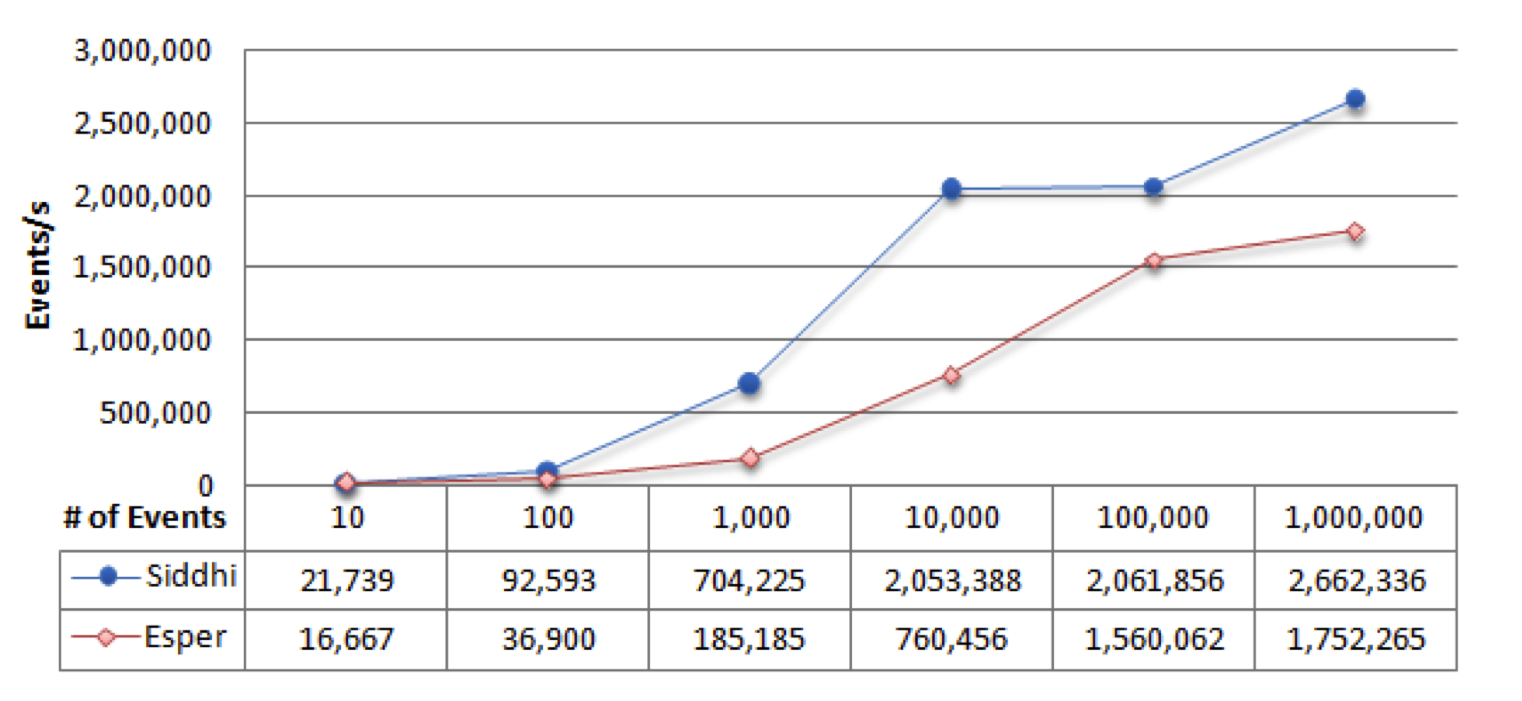
Following three graph's shows some of the key results of the Paper. Other CEP engine is Esper, which is a well-known opensource CEP engine. In the given scenarios we did from about 0.3 times to 10 times better.

Query 1: Filter (select symbol, price from StockTick(price>6))


Query2: Window (select irstream symbol, price, avg(price) from StockTick(symbol=’IBM’).win:time(.005))


Query3: Followed by pattern (select f.symbol, p.accountNumber, f.accountNumber from pattern [every f=FraudWarningEvent2 -> p=PINChangeEvent2(accountNumber= f.accountNumber)])


Siddhi is currently being used by
  • Los Angeles Smart Grid Demonstration Project
  • It forecasts electricity demand, respond to peak load events, and improves sustainable use of energy by consumers.
  • Open MRS NCD module – idea is to detect and notify patient when certain conditions have occurredhttps://wiki.openmrs.org/display/docs/Notifiable+Condition+Detector+%28NCD%29+Module
Also likely that future WSO2 Complex Event Processing Server would also use Siddhi, yes that is if it can continue to do better. Siddhi code can be found from http://siddhi.sourceforge.net/, and If you are interested to help, please join us at architecture@wso2.org for discussions.

CSE 2011 Keynote: Distributed Systems: What? Why? And bit of How?

Last week I did the keynote for the Annual research conference of Computer Science and Engineering Department, University of Moratuwa, and following are the slides I used. I had to talked about distributed systems in 30 minutes, and it was a interesting challenge. I will write down some of the things I talked about soon, specially the timeline for some of the distributed systems technologies.


View more presentations from Srinath Perera.

Tuesday, November 8, 2011

WSO2 Con 2011: Data Panel

Following is the recording of the data panel, and you can find the openning I did from here.